


Technology companies are taking increasingly global paths to growth.
Some build a strong foundation in their home market before expanding overseas. Others are designed for international markets from the outset. What connects them is not where their businesses are incorporated or where their founders come from, but a shared ambition to build products that can compete across markets.
DayDayUp is currently working with four companies entering their next stage of growth: Helios, Snowspaces, TBL and IntBot.
They operate in different sectors, from enterprise software and cybersecurity to industrial AI and embodied intelligence. Yet all four companies share a common ambition: turning proven products into globally scalable businesses.
Their paths are different. Their next-stage questions are remarkably similar: where to grow, how to localise, how to win customers and how to build sustainable international operations.
As companies expand across markets, travel and expense management becomes increasingly complex.
Different currencies, tax requirements, approval structures and accounting systems often create operational friction. Finance teams need visibility, compliance and efficiency, while employees expect a seamless experience across regions.
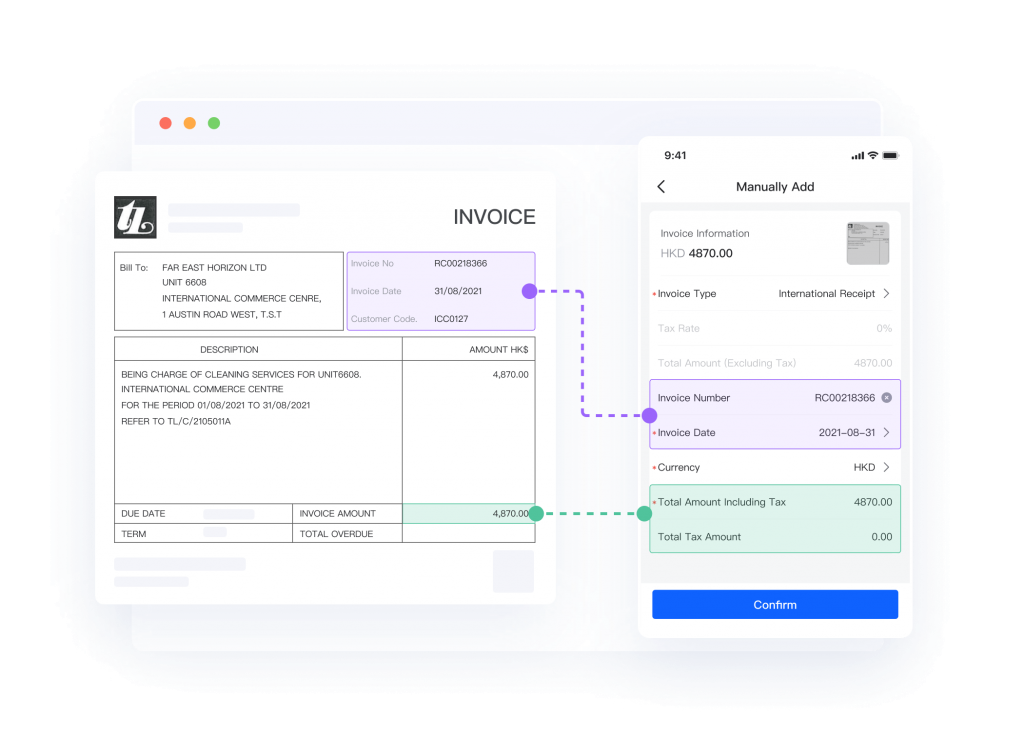
Helios provides an end-to-end travel and expense management platform covering travel requests, booking, expense claims, approvals, financial review, payment, accounting and reporting.
The platform also incorporates AI-powered tools for expense submission, financial review and multilingual support, helping enterprises automate routine workflows while maintaining compliance.
From a China-rooted expense management platform, Helios has evolved into a global provider serving more than 3,000 customers, including over 250 international companies and more than 20 Fortune 500 clients. The company has established operations, subsidiaries and data infrastructure across China, Singapore, Japan and Germany.
Helios views Singapore as a strategic hub for serving multinational customers across Asia-Pacific.
As the company continues its international expansion, its priorities include supporting more regional enterprises, strengthening ecosystem partnerships and delivering localised financial workflows that meet the needs of globally distributed organisations.
Industry Challenge
Enterprise AI adoption is accelerating, but many organisations still lack a secure way to give employees and external users access to sensitive systems and data.
The risk is particularly acute in regulated industries such as financial services, where employees handle confidential customer, transaction and corporate information that must remain tightly controlled.
The challenge also affects companies that give external vendors access to internal systems or allow employees to work through bring-your-own-device arrangements. In these environments, sensitive company data may be accessed through devices and networks that the organisation does not fully control.
Once information is copied, downloaded or entered into external AI tools, companies may lose visibility and control over how it is used.
Traditional security architectures often rely on separate VPN, virtual desktop, data-loss prevention and access-management tools. This fragmented approach creates operational complexity for IT teams and a cumbersome experience for users.
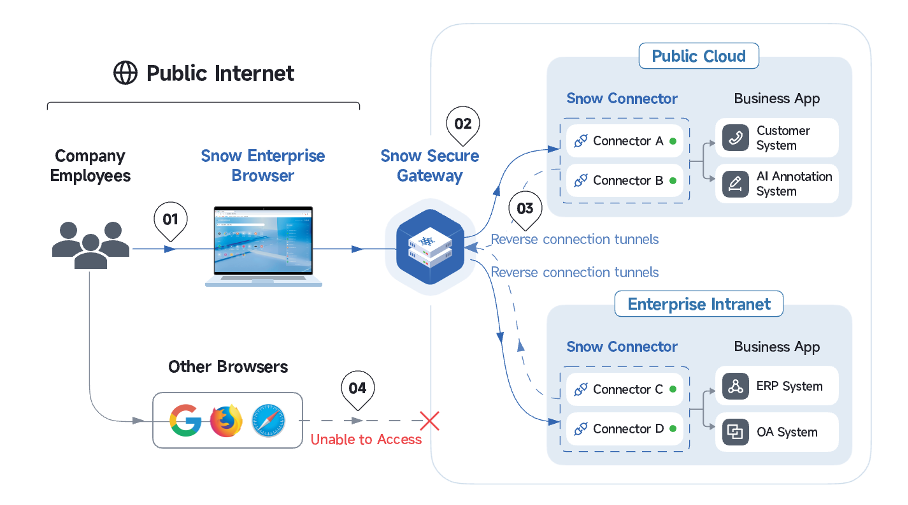
Snowspaces addresses these risks through an enterprise browser that becomes the controlled access point for company systems, data and AI tools.
The platform combines zero-trust access, data-loss prevention, behaviour controls, audit trails and an embedded AI assistant within a single environment. Because these controls are integrated into the browser layer, organisations can manage how users view, copy, download and share sensitive information without relying on multiple disconnected security products.
The company has secured more than 100 enterprise customers across sectors including manufacturing, automotive, finance and autonomous driving. Customers include organisations such as BYD, Bosch, Volkswagen and OKX.
Snowspaces brings together complementary expertise from industry and academia. Founder and CEO Gao Xuefeng has more than a decade of experience in enterprise security, browser technology and international business operations, including experience at 360 Security.
The company operates at the intersection of cybersecurity and enterprise AI, helping organisations adopt AI while maintaining governance and compliance.
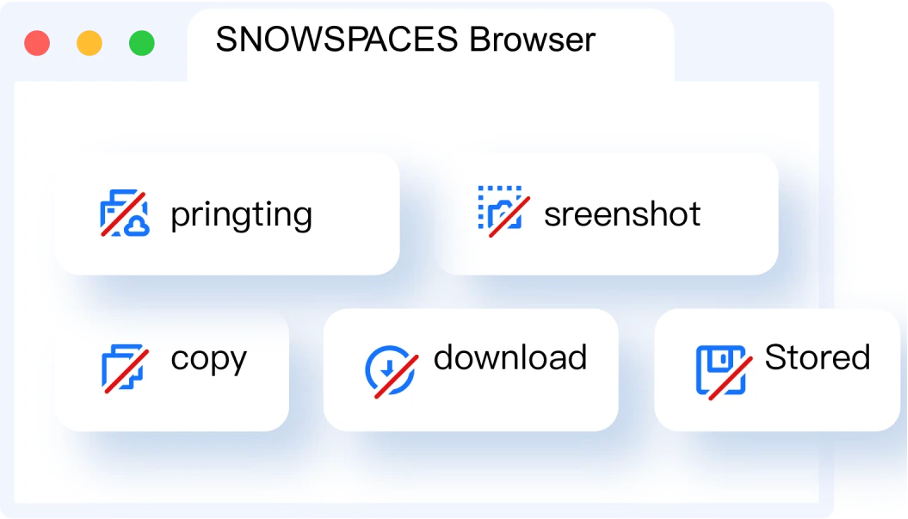
Snowspaces has established Singapore as its global headquarters and regional operating base.
The company sees significant opportunities across Asia-Pacific and the Middle East, where digital transformation, cybersecurity requirements and AI adoption are accelerating simultaneously.
Backed by investors including Granite, Snowspaces is now focused on expanding its enterprise customer base, strengthening channel partnerships and preparing for its Series A fundraising.
Factories, warehouses and logistics sites have spent decades automating individual processes.
However, most industrial systems still operate through predefined workflows and fixed resource allocation. When demand changes, supply chains shift or operational disruptions occur, human intervention is often required to redesign processes and reassign resources.
As industrial environments become more complex, traditional automation is reaching its limits.

TBL Solution
TBL is building a Physical AI platform designed to help industrial operations move from automation towards autonomy.
Its system combines real-time operational data, digital twins, simulation environments, AI decision-making and execution systems into a unified operating layer.
Rather than simply automating predefined processes, TBL enables AI to analyse changing conditions, generate alternative operating plans, verify them through simulation and coordinate execution across people, vehicles, equipment, robots and software systems.
The company has served more than 400 enterprises across over 40 industries and accumulated more than 100 industrial scenario models.
In 2026, TBL was recognised by Logistics Tech Outlook APAC as one of the region’s leading intelligent logistics platforms, highlighting its growing influence in industrial and logistics operations.
As manufacturers and logistics operators seek greater resilience and efficiency, demand for intelligent operational systems continues to grow.
Singapore provides access to multinational manufacturers, logistics providers, innovation ecosystems and regional partners that can support TBL’s next phase of international expansion.
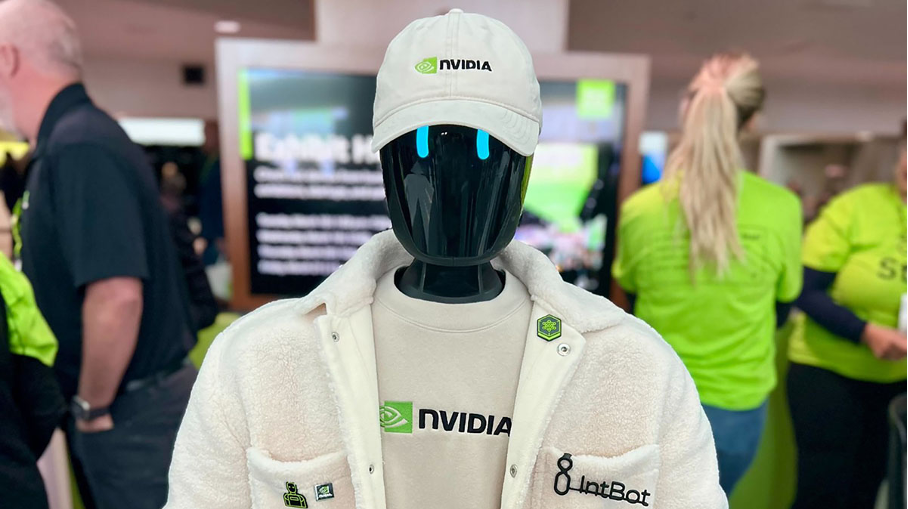
Most robots operating in public and customer-facing environments are designed to navigate, deliver items or answer predefined questions.
They often lack the social intelligence required to recognise conversational context, respond naturally and adapt their behaviour to the person in front of them.
This limitation becomes more visible in airports, hotels, conferences, exhibitions and public venues, where robots must interact with people across different languages, cultures and levels of familiarity with technology.
At the same time, these environments face peak traffic, staffing constraints and inconsistent service delivery. Organisations therefore need robots that can do more than execute tasks. They must understand how to engage people effectively.
IntBot is building the social intelligence layer for embodied AI, delivered through a Robot-as-a-Service model for customer-facing environments.
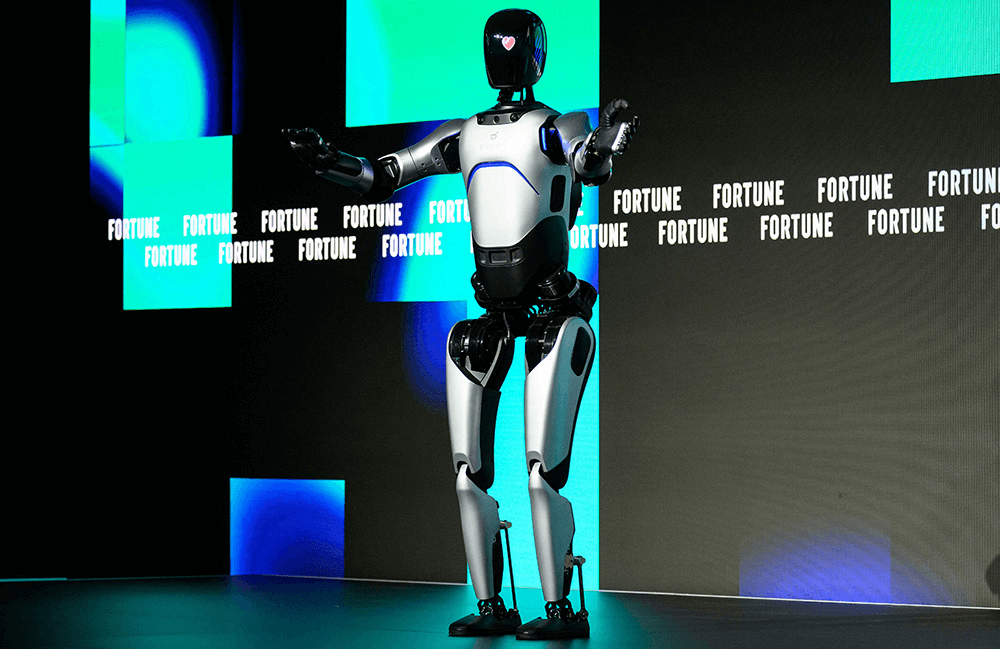
Its flagship robot, Nylo, acts as an always-on brand ambassador capable of greeting visitors, answering questions, providing directions and communicating in more than 50 languages.
Designed for high-traffic environments, Nylo helps organisations deliver consistent customer engagement while creating memorable and shareable visitor experiences.
The platform has already been deployed at San José Mineta International Airport, CES, NVIDIA GTC and a range of hospitality and event venues.
Rather than replacing human staff, IntBot enables teams to scale guest engagement and strengthen brand presence through intelligent physical interaction.
Singapore’s position as a regional hub for aviation, hospitality, tourism and events makes it an attractive market for customer-facing robotics.
As IntBot expands internationally, the company is seeking partnerships with venue operators, hospitality groups, event organisers and ecosystem stakeholders that can accelerate adoption across the region.
It is also exploring fundraising opportunities to support product development, commercial deployment and international growth.
Helios supports the financial workflows behind international operations.
Snowspaces secures enterprise access and AI adoption.
TBL helps industrial organisations move towards autonomous operations.
IntBot gives robots the social intelligence required to interact with people.
Their products are different, but their next-stage priorities are remarkably similar.
Building a strong product is only the beginning. International growth requires companies to identify the right markets, win local customers, build trusted partnerships, navigate regulatory environments and communicate their value clearly to investors.
This is where DayDayUp’s work begins.
DDU supports growth-stage companies through two complementary business lines: SEASTAR and Financial Advisory.
SEASTAR helps technology companies expand into Singapore and Southeast Asia.
The programme supports companies in assessing market demand, refining positioning, identifying pilot opportunities and connecting with prospective customers, channel partners and ecosystem stakeholders.
The objective is not simply market entry. It is to help companies build a practical pathway towards sustainable local revenue and long-term regional operations.
Financial Advisory: Connecting Growth with Capital
International expansion also requires capital.
DDU’s Financial Advisory practice helps growth-stage companies strengthen fundraising narratives, prepare investor materials and connect with relevant financial and strategic investors.
The focus is on translating technical capabilities and commercial traction into a clear and credible investment case.
For companies pursuing international expansion and fundraising simultaneously, market development and capital strategy must reinforce one another. Customer adoption validates demand, while capital enables localisation, team building and regional delivery.
The next generation of globally successful technology companies will not be defined solely by where they were founded.
Their success will depend on their ability to operate across markets, serve local customers and build international organisations.
Helios, Snowspaces, TBL and IntBot represent four different approaches to that journey.
Through SEASTAR and Financial Advisory, DayDayUp is helping these companies transform global ambitions into customers, partnerships and capital opportunities.
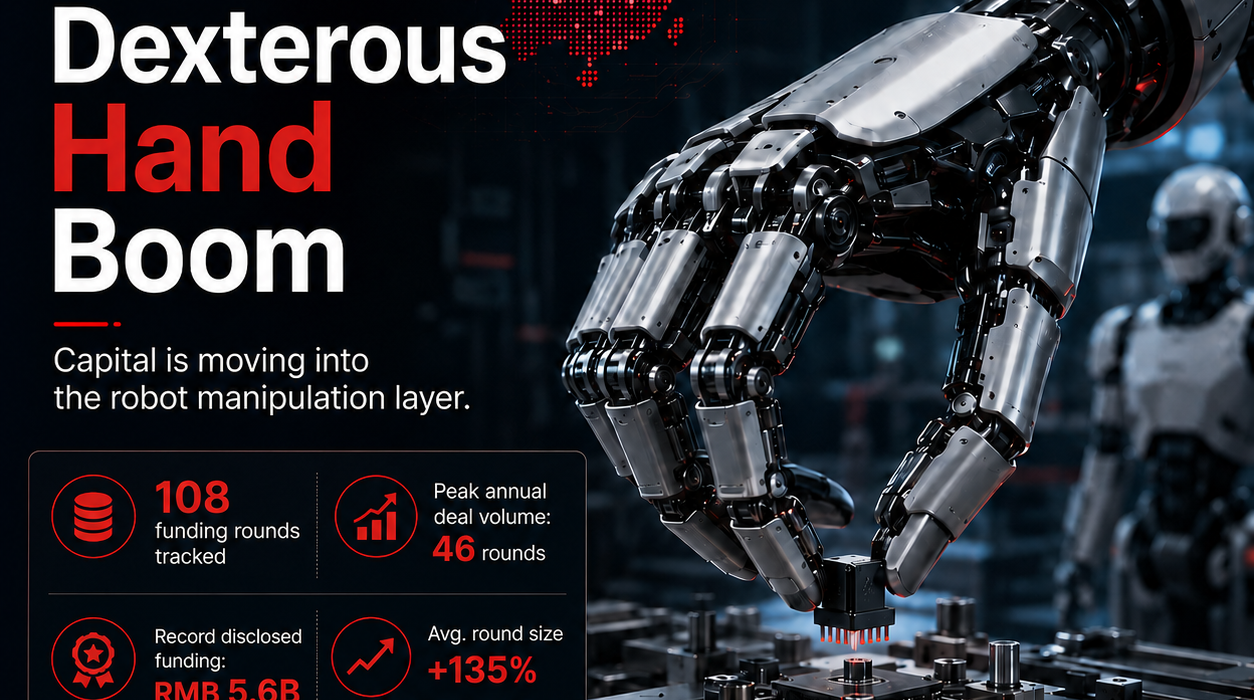
For the past two years, China’s embodied AI boom has centered on full humanoid platforms. In 2026, capital is moving down the stack. Dexterous hands, once treated as a lab component, are now being priced as a standalone supply-chain category.
The logic is practical. Walking robots attract attention, but hands create utility. A humanoid can only work in factories, warehouses, and service environments if it can grasp, sort, press, plug, assemble, and handle objects with control. That makes the hand layer commercially important and repeatable across multiple robot makers.
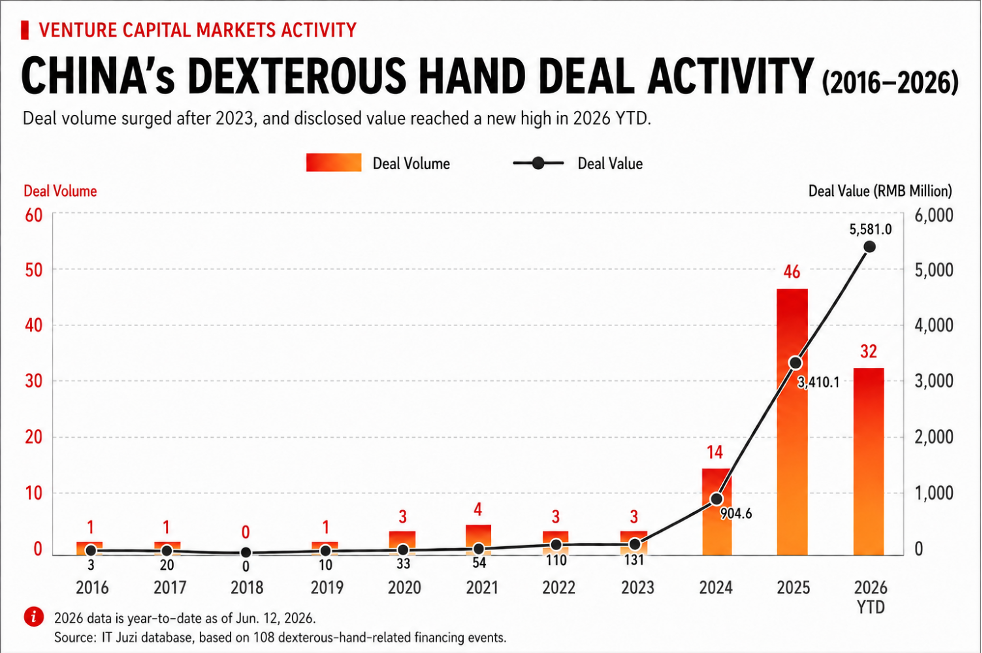
The 108 dexterous-hand-related funding rounds reveal a clear shift in investor attention:
Dexterous hands are moving from a research component to a strategic supply-chain category. Investors increasingly view them as critical infrastructure for deploying humanoid robots in factories, warehouses, and service environments.
This article highlights five companies that illustrate how capital is flowing into China’s dexterous hand market. Rather than forming a ranking, they represent distinct investment signals: valuation, production capacity, strategic investment, supply-chain positioning, OEM incubation, and early-stage pipeline formation.
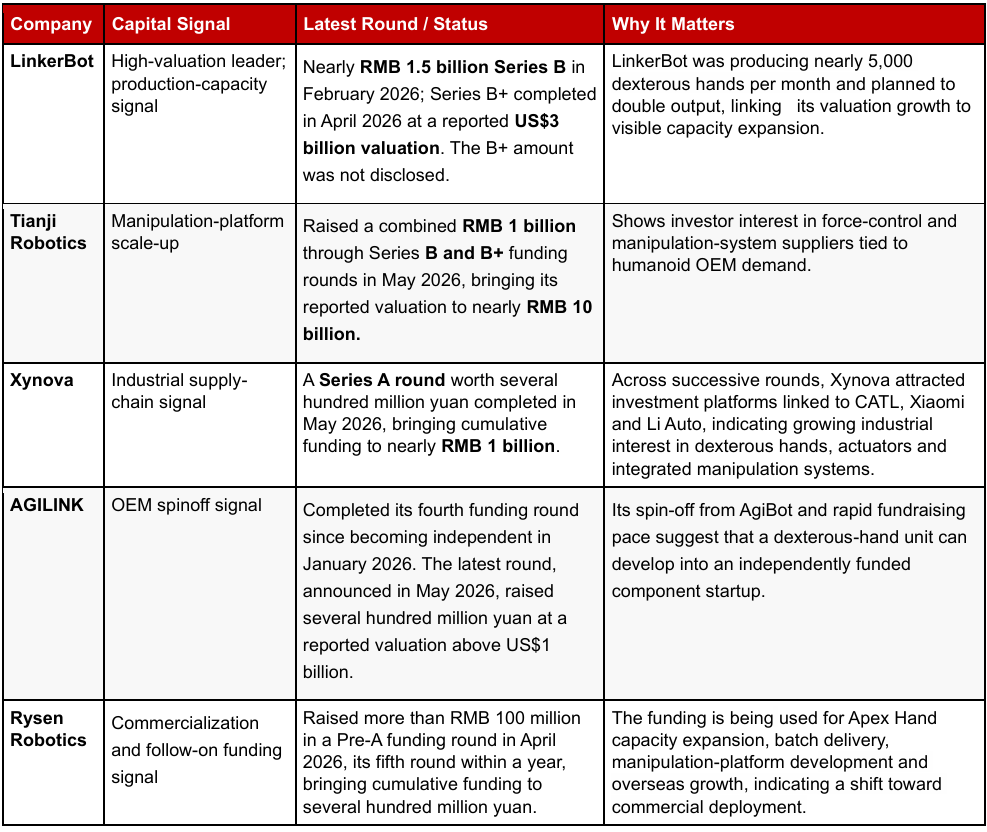
China’s dexterous hand market is not moving in one straight line. Three layers are forming at the same time: valuation leaders, strategic component suppliers, and younger companies linked to future OEM demand.
LinkerBot is the clearest valuation signal. Public reports indicate that the company completed a nearly RMB 1.5B Series B round, reached a RMB 10B post-Series B valuation, and later moved towards an even higher valuation after Series B+. The numbers still need publication-stage verification, but the direction is clear: investors are trying to identify default suppliers before large OEM procurement cycles fully accelerate.
This pricing is based on expectation, not only current revenue. If humanoid robot shipments scale, dexterous hands could become repeat-purchase hardware. Suppliers with stable performance, production capacity, and early OEM relationships may become hard to replace. This commercial potential is beginning to command a valuation premium from investors.
Tianji Robotics and Xynova show a different signal. They are not only raising money; they are attracting investors that care about the future structure of the robotics supply chain.
Tianji Robotics is reported to serve more than 45 humanoid robot OEM customers has with a backlog of more than 10,000 units. That customer base is a stronger signal than another demo video. It suggests that downstream demand has already started to form.
Xynova’s investor base points in the same direction. Investment platforms linked to CATL, Xiaomi, and Li Auto bring manufacturing experience, hardware supply-chain knowledge, and long-term exposure to intelligent machines. Their participation suggests that dexterous hands are being evaluated not only as a venture bet, but also as a potential control point in embodied AI hardware.
AGILINK and Rysen Robotics should not be read through the same lens as LinkerBot. Their importance lies less in current valuation scale than in what they reveal about market structure.
AGILINK matters because it was incubated by AgiBot, one of China’s leading humanoid robot platforms. Its fourth funding round in five months shows that investors are willing to back dexterous-hand businesses as standalone component companies.
If a hand module can raise capital, sell to multiple customers, and build its own roadmap, it is no longer just an internal part of a robot stack. t is beginning to emerge as a standalone component category.
Rysen Robotics represents the commercialisation path. Proceeds from its latest funding round will be used to expand Apex Hand production capacity, support batch deliveries and develop overseas markets.
The investment logic is shifting from platform hype to supply-chain pricing. Full humanoid robots still receive the most attention, but investors are now asking which component layers can capture durable value once OEMs begin to scale.
Dexterous hands are attractive because the revenue path may be shorter than full humanoid platforms. They are modular, upgradeable, and sellable across multiple robot makers. They may also enter industrial automation scenarios before full humanoid deployment becomes mature.
The market is still too early for a stable ranking. What matters is the role each company plays in the stack: leader, supplier, spinoff, or pipeline company.
China’s humanoid robot race is no longer only about who can build the most impressive full-body machine. It is also about who controls the components that make the machine useful.
Dexterous hands sit at that intersection. They are technically difficult, commercially necessary, and increasingly investable. The companies attracting capital today are competing to become part of the default supply chain for embodied AI.
The next phase of China’s robotics market may therefore be less about demos and more about procurement. When OEMs begin to scale, the winners will not only be the robot brands on stage. They may also be the component suppliers hidden inside the machine.
Sources: IT Juzi database; Cyzone; 36Kr English; Gasgoo; Bloomberg; The Next Web; EqualOcean; Yicai Global; company announcements and public reporting reviewed by DayDayUp Research Team.
DayDayUp Research Team | Singapore & Beijing
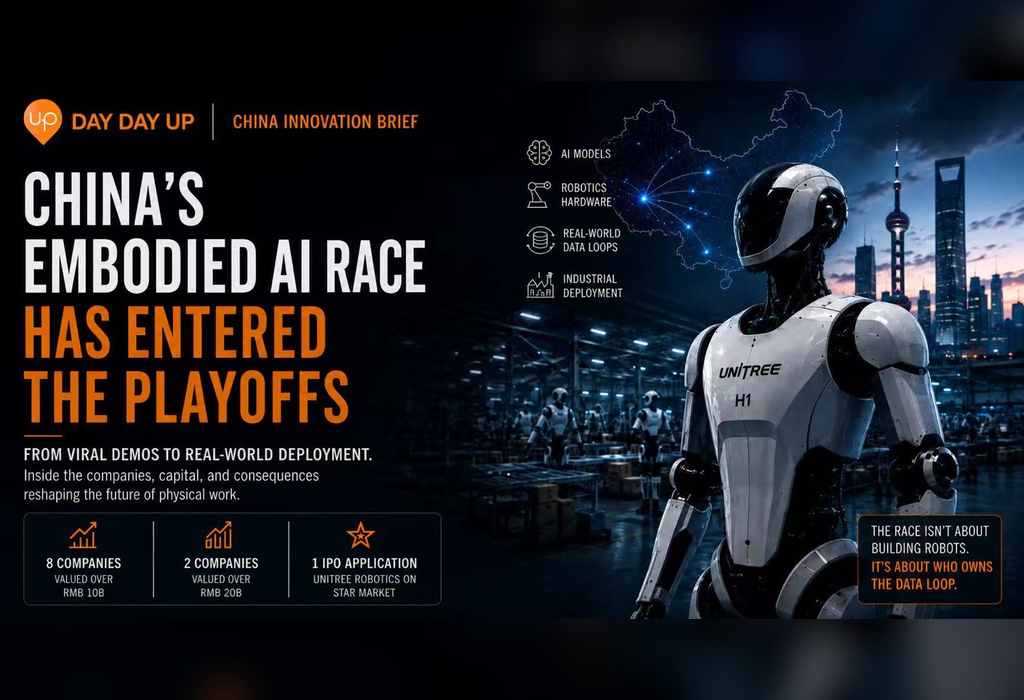
Something shifted in China’s robotics industry in 2025 — and it happened faster than most observers expected.
Embodied AI, the field that combines large language models with physical robot bodies, moved from research labs and trade show floors into factories, warehouses, and commercial contracts. Capital followed at an unprecedented pace: Chinese embodied AI companies raised ¥73.5 billion ($10.8 billion) across 744 deals in 2025 alone. In the first five months of 2026, another ¥30 billion-plus entered the sector — averaging roughly ¥330 million per day.
Eight companies have now crossed the RMB 10 billion valuation threshold. Two are valued above RMB 20 billion. The first IPO has been approved. A new industrial category is taking shape in real time.
This is no longer a story about China’s robotics ambitions. It is a story about a technology transition that is already underway — and one that will reshape manufacturing, logistics, and labour economics globally.
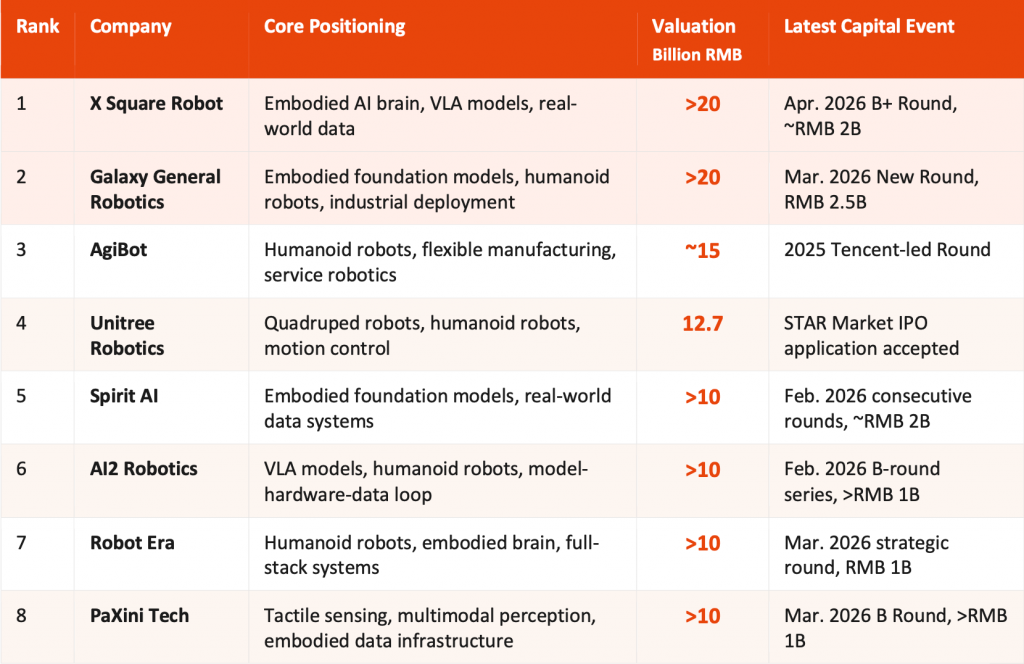
China’s top eight embodied AI companies are not building the same thing. They are each competing to occupy — or control — a distinct layer of a technology stack that, in its mature form, will integrate AI foundation models, physical hardware, real-world training data, deployment infrastructure, and commercial go-to-market capacity. Understanding the stack is the prerequisite for understanding the race.
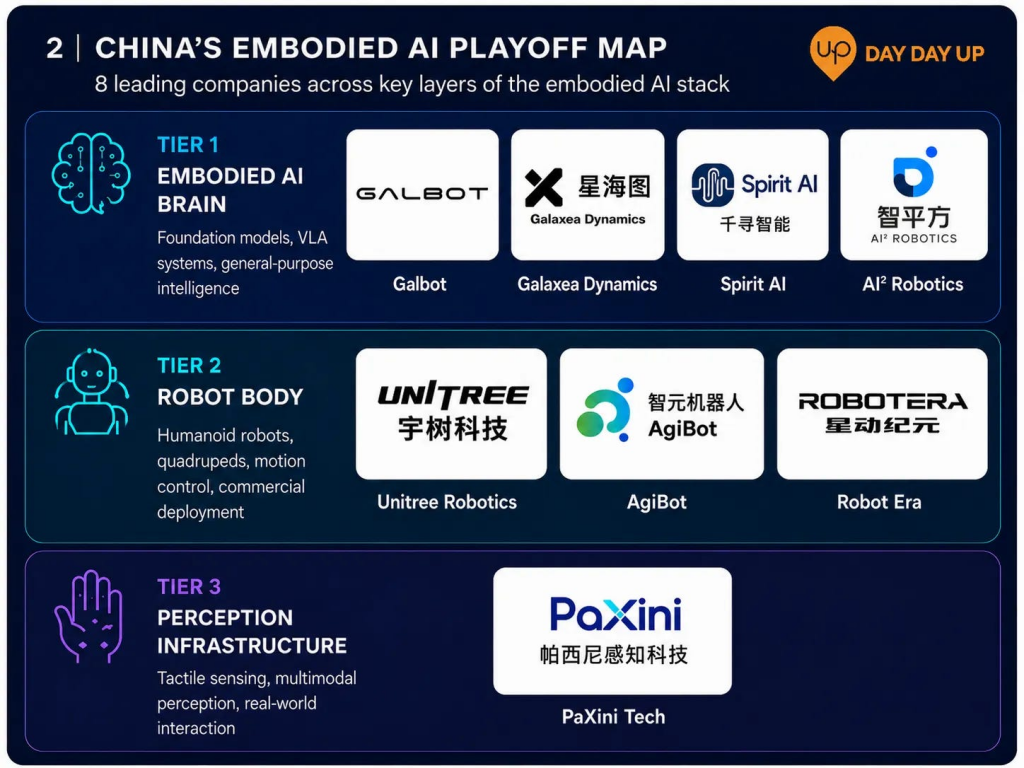
At the top of the stack are companies competing to build the intelligence layer of embodied AI.
Galaxy General Robotics, Galaxea Dynamics, Spirit AI, and AI² Robotics sit in this category.
Their strategic value is not limited to the robot body. It lies in the models, data systems, and intelligence infrastructure that allow robots to understand environments, interpret instructions, and execute physical tasks.
This is where vision-language-action systems become central.
A VLA system connects perception, language understanding, and physical execution. In simpler terms, it helps a robot understand what it sees, process what a human asks it to do, and decide what action to take next.
For overseas investors, this layer is particularly important because it looks less like traditional robotics manufacturing and more like AI infrastructure applied to the physical world.
Robot bodies may be replaced, upgraded, or produced by different hardware vendors. But a generalisable intelligence layer that can run across different platforms, task types, and deployment environments could become much more valuable.
In the long run, the “brain layer” may become the operating system of physical AI.
The key investment question is therefore not simply whether these companies can build advanced models.
It is whether their models can generalise, improve through real-world data, and translate intelligence into reliable physical action.
The second layer is where embodied AI becomes visible to customers.
This is the layer of robot bodies, full-stack systems, motion control, hardware integration, supply chain execution, and commercial deployment.
Unitree Robotics, AgiBot, and Robot Era are positioned here.
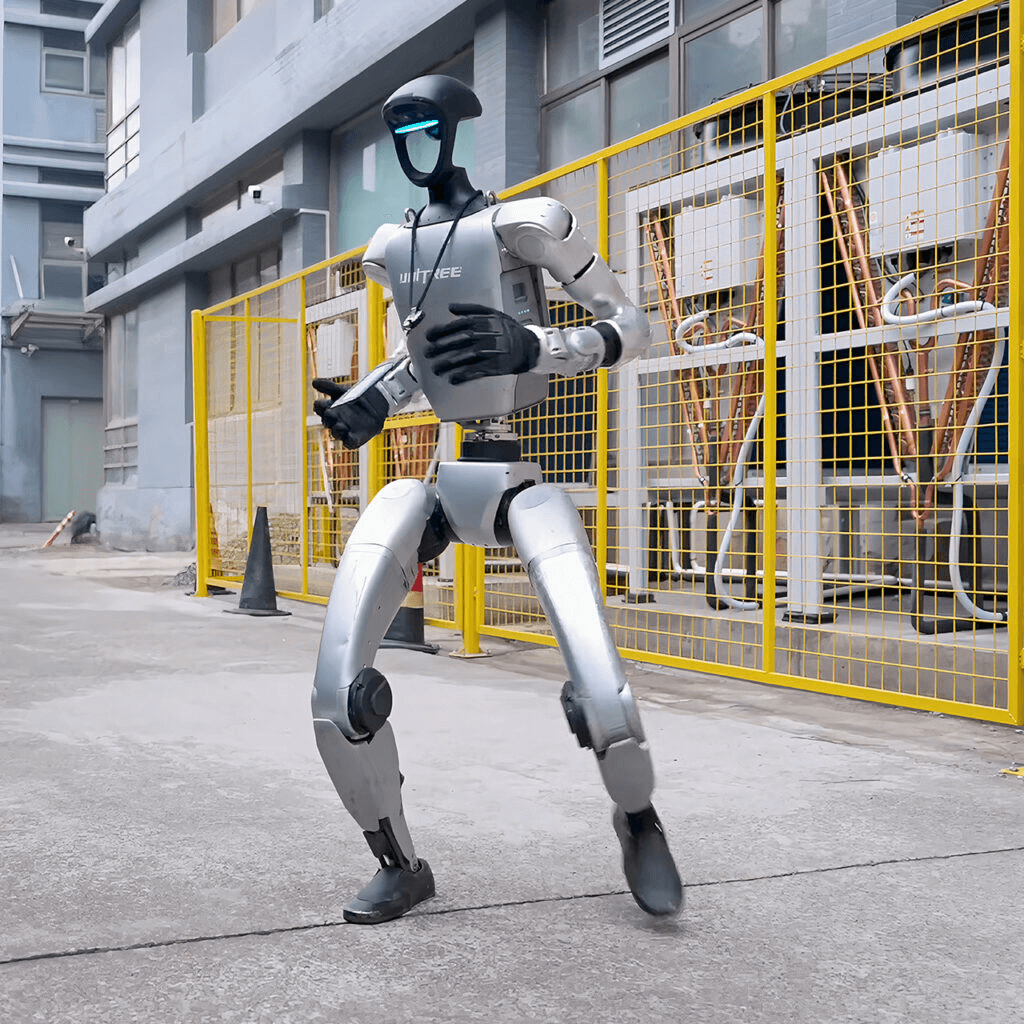
Unitree Robotics is one of the most important companies to watch because it represents commercial discipline in a sector that is still highly experimental. The company has built strong global recognition through quadruped robots and is now moving further into humanoid systems. Its relevance is not only technological. It also reflects China’s strength in hardware iteration, cost control, and productisation.
AgiBot represents another important route. It is one of China’s most visible humanoid robotics companies, backed by strong technical narratives and strategic capital. The market expectation is clear: AgiBot needs to convert visibility into deployment volume, customer traction, and recurring commercial value.
Robot Era adds another dimension to this layer. Its relevance lies in connecting robot systems with industrial scenarios. In embodied AI, commercialisation is not just about building a robot that can move. It is about integrating robots into factories, warehouses, logistics workflows, and other operational environments where ROI can be measured.
This layer is difficult because it requires multiple capabilities at once.
A company needs hardware engineering, motion control, supply chain management, safety systems, software integration, field operations, and after-sales support. A robot that performs well in a controlled demo environment is very different from a robot that can operate repeatedly in a real commercial setting.
For investors, the core question is straightforward:
Can these companies build robots that work reliably, repeatedly, and economically in the real world?
If the answer is yes, they are no longer just robotics startups.
They become automation infrastructure companies.
The third layer is perception infrastructure.
PaXini Tech focuses on tactile sensing and multimodal perception, a critical but often under-discussed part of embodied AI.
For robots to operate in the physical world, vision is not enough. They also need to understand pressure, force, contact, and material interaction. This becomes especially important in tasks that require grasping, handling, assembling, or manipulating objects with precision.
From an investment perspective, PaXini Tech represents a focused infrastructure bet.
As robot bodies become increasingly standardised, specialised sensing capabilities may become an important source of differentiation. In that sense, PaXini is not simply a component company. It is addressing one of the key bottlenecks that will determine whether embodied AI can move from controlled demos to real-world work.
China has invested in robotics before. Previous waves produced capable hardware in controlled environments but limited commercial adoption. The current cycle is different in four important ways.
Foundation models have changed what robots can do. The rapid improvement of large language models from 2022 onwards created, almost as a byproduct, the architectural foundation for vision-language-action systems. The ability to train robots on language instructions, visual inputs, and physical feedback simultaneously — and to generalise that training across task types and environments — compressed the timeline for commercially useful embodied AI from “decades away” to “under active deployment.” Companies that began serious research in 2022 or 2023 are running real pilots with real customers as of mid-2026.
Data loops are becoming the primary competitive moat. In previous robotics cycles, success was measured in lab performance metrics and trade show demonstrations. This cycle will be decided by data. Every hour a robot operates in a factory, warehouse, or logistics hub generates training signal that refines the models running all subsequent robots. Companies that achieve early deployment at scale compound a model advantage in ways that late entrants cannot replicate. This is the structural insight most coverage of Chinese robotics misses: the robot body is a distribution mechanism. The real product is the deployment data.
Real-world deployment — not demos — is the benchmark. Commercial contracts, production unit counts, and disclosed unit economics are now the metrics that matter. Unitree’s IPO application forces a public reckoning with what this sector is actually worth. Every other valuation in the cohort will ultimately be measured against what the public market decides Unitree is worth.
China’s manufacturing ecosystem provides structural cost advantages that are compounding. China’s precision electronics supply chain — motors, sensors, actuators, and structural components — is not merely cost-competitive; it is qualitatively superior in iteration velocity. A Chinese robotics startup can test, redesign, and remanufacture a motor assembly in weeks. This is the product of decades of sustained manufacturing investment, and it is why the cost curve is falling faster than most observers anticipated. IDTechEx projects average humanoid robot prices declining 68% by 2030 — from roughly $115,000 in 2024 to around $37,000. Goldman Sachs forecasts manufacturing costs reaching $15,000–$20,000 per unit at scale. Bank of America’s research projects commercial-grade units at $13,000–$17,000 by the same year. Unitree’s G1 already retails at $16,000 today.
The embodied AI transition carries structural implications for global manufacturers, supply chains, and labour markets — and the timeline is compressing faster than most corporate planning assumptions reflect.
The productivity impact is real, and deployment has already begun. Figure AI’s F.02 humanoid contributed to the production of more than 30,000 BMW vehicles at the Spartanburg plant in the United States. BMW announced its first European humanoid robot deployment at its Leipzig facility in February 2026. These are not pilots in controlled conditions; they are production-line deployments generating commercial output. For global manufacturers, the question is no longer whether embodied AI will reach commercial maturity — it is whether their organisations are prepared to evaluate and adopt it on a competitive timeline.
Supply chain implications are strategic, not just operational. Companies that depend on labour-intensive manufacturing in any geography need a forward view on how embodied AI changes their cost structures. As unit prices move toward the $20,000–$30,000 range projected by 2030, the economics of robot adoption become compelling in an expanding set of manufacturing environments. Procurement leaders and operations teams that begin evaluation now will have a meaningful advantage over those waiting for the technology to “fully mature.”
The standards race is underway. Whoever achieves early large-scale deployment sets the de facto performance benchmarks, data protocols, safety standards, and integration interfaces that subsequent adopters build around. In enterprise software, this is the standards lock-in dynamic. In physical AI, it will operate similarly — but intersecting with regulatory frameworks, workplace safety law, and national industrial policy in ways that software standards do not. Companies that achieve first-mover deployment will have significant influence over how global standards evolve.
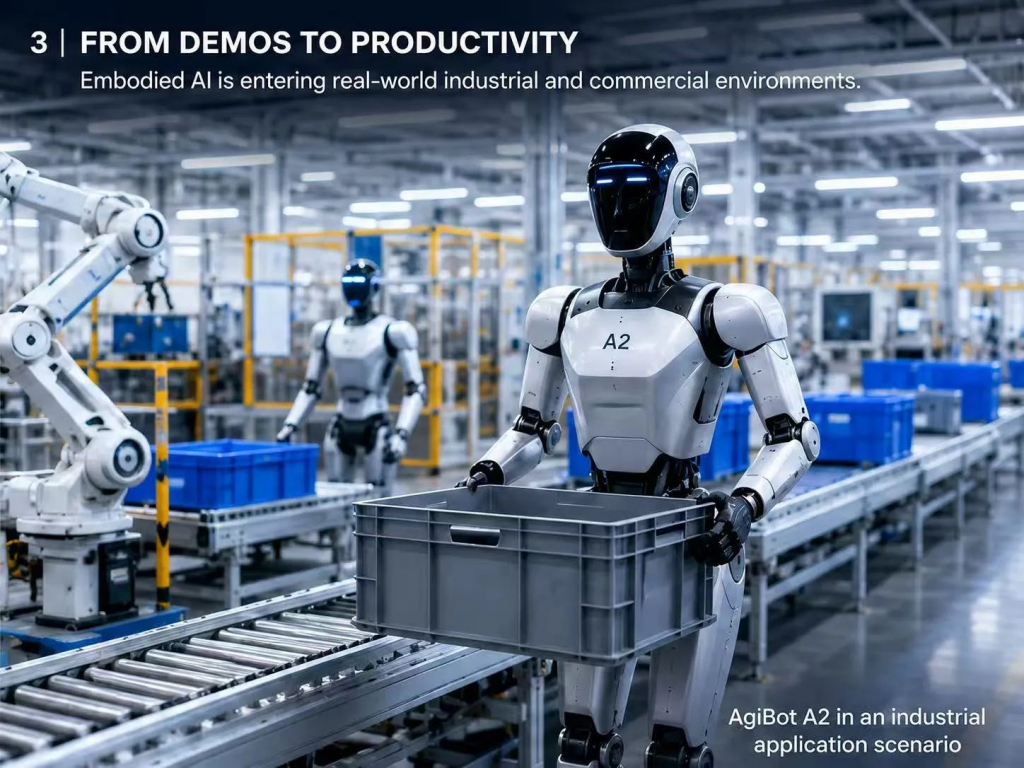
Southeast Asia occupies a specific position in the global embodied AI deployment sequence — one that requires both strategic realism and forward planning.
The first wave of large-scale commercial deployment is concentrating in high-labour-cost markets. Japan Airlines’ Unitree G1 trials at Haneda Airport, BMW’s humanoid deployments in the United States and Germany, and early logistics automation in South Korea all follow the same economic logic: where labour is expensive and hard to source, the payback economics of a $50,000–$100,000 robot are compelling today. Southeast Asia, with structurally lower labour costs, is more realistically positioned as a second-wave market — one that becomes commercially compelling as robot unit prices fall toward the $20,000–$30,000 range projected by 2030.
Manufacturing and warehousing are the most immediate verticals to watch. Southeast Asian factories in electronics, consumer goods, and automotive components represent the sector where cost curves will intersect with adoption thresholds earliest. Logistics and warehousing operations — particularly those serving the region’s fast-growing e-commerce sector — are a natural early deployment environment as unit prices decline and deployment tooling matures.
Singapore’s strategic role is as a hub, not just a market. The more immediate opportunity for Singapore-based investors, corporates, and professional services firms is not as end-market adopters of embodied AI hardware, but as the governance, financing, and IP structuring layer connecting Chinese technology supply with global demand. Companies building Singapore-domiciled holding structures, neutral IP jurisdictions, and transparent international governance frameworks will access a significantly wider global customer base. This is an underpriced source of competitive advantage — and one where Singapore has genuine structural advantages to offer.
Industrial services and supply chain transformation will follow. As embodied AI platforms mature beyond initial manufacturing applications, industrial services, inspection, maintenance, and logistics will represent the next adoption frontier in Southeast Asia. Companies managing cross-border supply chains that currently depend on labour-intensive processes should begin scenario planning that incorporates this transition now.
The winners of China’s embodied AI race will not necessarily build the most impressive robots.
They will build the strongest data loops — accumulating operational intelligence from real-world deployment at scale. They will build the deepest deployment networks — reaching factories, warehouses, and service environments across China and increasingly beyond. And they will build the clearest commercial discipline: unit economics that hold, governance structures that travel, and revenue models that compound.
Eight companies are in the playoffs. The next eighteen months will determine who advances — and what the rest of the world has left to work with.
DayDayUp Research Team | Singapore & Beijing
Sources:
Brookings Institution — China’s Shrinking Population and Constraints on Its Future Power
World Economic Forum — Future of Jobs Report 2025
MERICS — Embodied AI: China’s Ambitious Path (April 2026)
IDTechEx — Humanoid Robot Price Falls 68% by 2030, Six-Month Payback Possible Now
Goldman Sachs — The Global Market for Humanoid Robots Could Reach $38 Billion by 2035
Bank of America Robotics Research (via There’s a Robot for That) — Humanoid Robot Cost 2026
Figure AI — F.02 Contributed to the Production of 30,000 Cars at BMW
BMW Group Press — BMW Group to Deploy Humanoid Robots in Production in Germany for the First Time

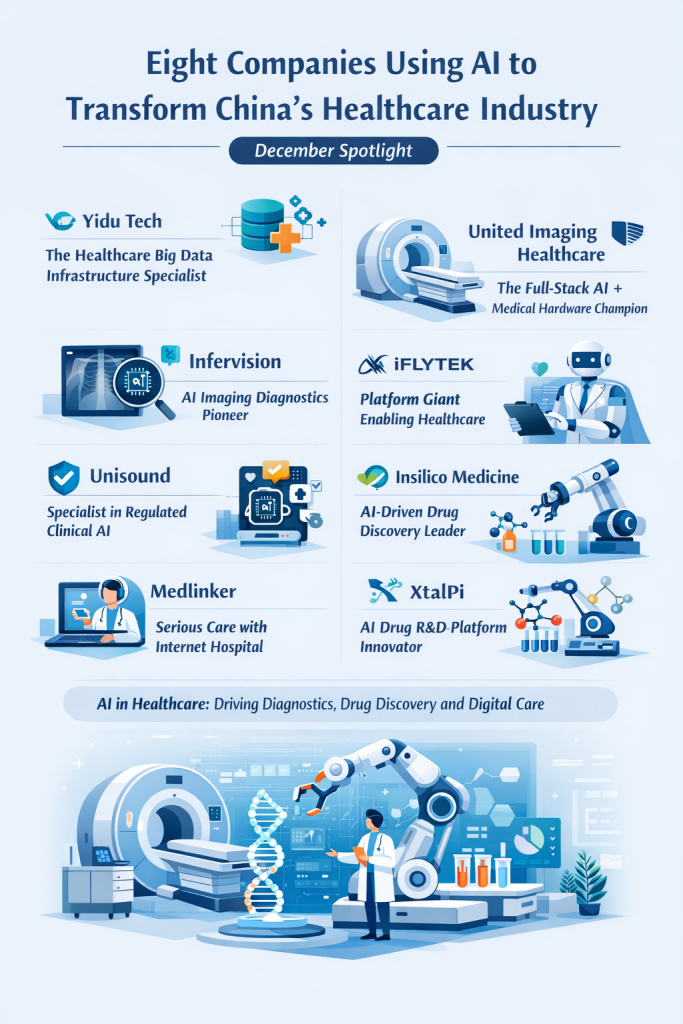
China’s AI-driven healthcare sector has moved beyond experimentation into scaled, real-world deployment. A new wave of representative companies is reshaping the industry from multiple angles—clinical diagnosis, drug discovery, healthcare services, and data infrastructure. Below are eight standout players and how they are driving change.
How it drives transformation:
In one sentence: Not a “doctor” that treats patients, but the infrastructure provider supplying the “oil” (data) and “refinery” (analytics) that power the entire healthcare system.
How it drives transformation:
In one sentence: It makes expensive medical equipment not only “see clearly,” but also “understand what it sees.”
How it drives transformation:
In one sentence: A leading example of Chinese AI healthcare going global—and winning on quality.
How it drives transformation:
In one sentence: iFLYTEK goes “from general to vertical,” using a strong AI platform to enable multiple healthcare workflows.
How it drives transformation:
In one sentence: Unisound is “deep and specialized,” building high-barrier products that directly reshape core clinical processes.
How it drives transformation:
In one sentence: It tackles pharma’s biggest pain point—the “rule of 10s” (often ~10 years, ~$1B)—with AI-first R&D.
How it drives transformation:
In one sentence: It aims to rebuild chronic and serious care pathways through “internet hospital + AI.”
How it drives transformation
In one sentence: XtalPi is not just an AI drug discovery service provider—it’s a risk-sharing, value-sharing platform demonstrating that AI can produce real drugs and real outcomes.
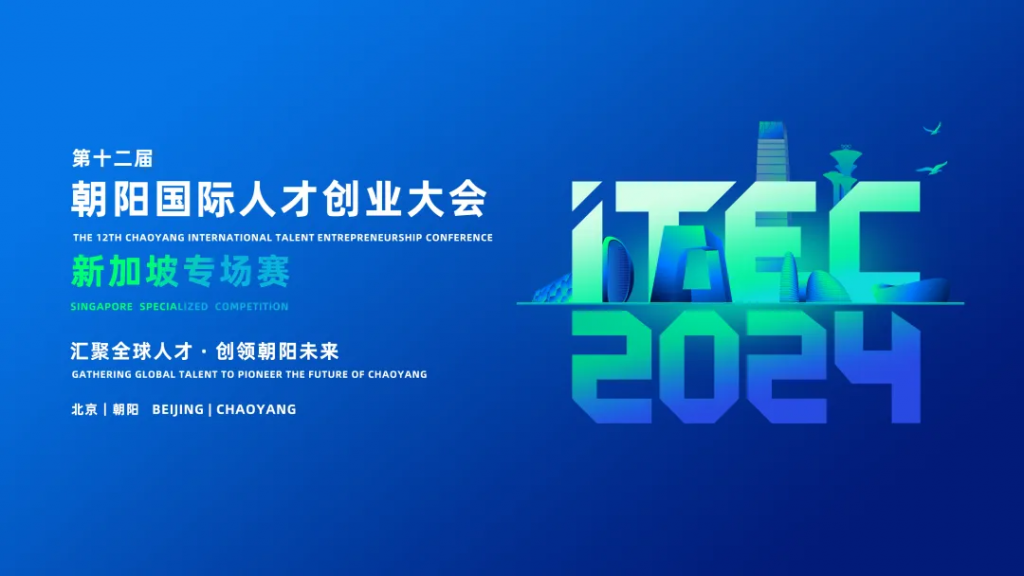
ITEC Background
The Chaoyang International Talent Entrepreneurship Conference (ITEC) is a renowned platform for international talent in innovation and entrepreneurship. Currently at its eleventh edition, ITEC has attracted over 50,000 entrepreneurs, more than 10,000 companies, and hundreds of renowned venture capital institutions from 73 countries and regions. It has facilitated the implementation of 1,128 companies in Beijing, attracting and leveraging over 30 billion yuan in investments.
Competition Categories
X Track:
Participation Rights and Benefits:
Winning companies from the special competition can advance directly to the ITEC Global Finals.
In addition to the exclusive benefits of the special competition, companies participating in the ITEC Global Entrepreneurship Competition and winning will receive additional incentive services.
Prizes
Timeline



















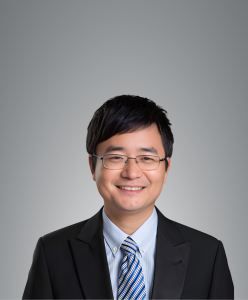






























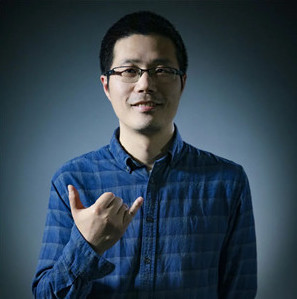










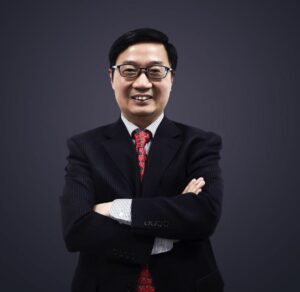
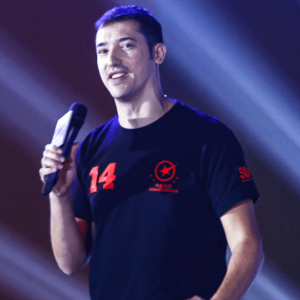 Partner & Managing Director at Chinaccelerator
 Co-founder & CMO, WebEye
 Director, Startup and VC Ecosystem, Samsung Catalyst
 General Partner at SOSV & Managing Director at Chinaccelerator & MOX
 Managing Director & US/Europe head at Fosun RZ Capital
 Founding Partner, Follow[the]Seed
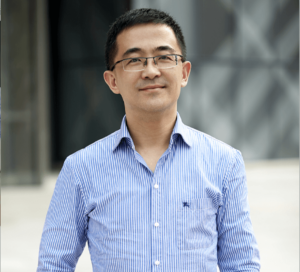 Co-founder of Dianping,Founding Partner of Light-Up Capital
 Founding Partner,MFund
 Peakview Capital,Managing Partner
 Founding Partner, NEO Global Capital
 Principal at Bain Capital Ventures
 Partner at HAX / SOSV, VC for 200+ deep tech startups. Speaker, Guest Writer at TC, VB & more. 18y in Asia